• Skip to primary navigation
  • Skip to main content
  • Skip to footer
American Idea Foundation

American Idea Foundation

Measuring Results, Expanding Opportunity, Improving Lives.

  • Contribute
  • About
    • Paul Ryan
    • Our Team
  • Mission
    • 2024 Progress Report
  • Approach
  • News
    • Blog
    • Press
  • Contact

Mike

Fox News Op-Ed: Stop the insanity. Our national debt now tops $35 trillion…

October 3, 2024 by Mike

By: Paul Ryan & Matt Weidinger

The buck never stops with either political party. That has to end

America’s political leaders have a spending problem. 

They know entitlement programs feature benefit promises far exceeding their tax base, but have done nothing to make them sound. Meanwhile, both parties demand more spending increases — despite the national debt soaring to $35 trillion, or more than $100,000 for each American, rich and poor alike. Under rosy assumptions, over $20 trillion in debt is projected to be added over the next decade.  

Yet despite the foreboding outlook, the major presidential campaigns have no plan to deal with current structural deficits and are outbidding each other to make them worse. For them, the buck stops elsewhere. That may be good short-run politics, but it will only make the inevitable bill bigger and even harder for everyday Americans to pay. 

Some argue tax cuts are to blame for the soaring debt. But as data from the nonpartisan Congressional Budget Office shows, revenue has remained largely stable while spending has grown significantly above prior levels.

Much of the growing debt is baked into the budgetary cake, and experts have long warned about rising costs when the Baby Boom generation retires. But growing Social Security payouts — long ago engineered to rise faster than prices — are only part of the problem. Soaring health spending, driven by the same demographic factors and compounded by exploding medical costs, is an even bigger challenge. 

America’s mountain of debt has been exacerbated by massive so-called emergency spending enacted by both parties. During the pandemic, legislation added over $5 trillion to the debt. Now the nearly $1 trillion in annual interest on the debt exceeds all federal spending on children, and defense spending, too. 

Efforts to balance the budget are repeatedly dismissed. As chairman of the House Budget Committee, one of us regularly proposed and passed balanced budgets, only to see hope for such discipline overcome by a desire for ever-greater spending. Important-sounding commissions (including one dubbed the “supercommittee”) issued detailed recommendations that were mostly ignored.  

Experts produced reams of data showing nations deep in debt inevitably reach a financial crisis, even as proponents of modern monetary theory (MMT) argued no amount of spending is too great. According to MMT advocates, the federal government can always print more money.    

Americans have already experienced where inaction and that illogic lead. During the pandemic, former Obama Treasury Secretary Larry Summers warned that massive new federal spending would lead to significant inflation, which is exactly what happened, with prices growing 20% since the start of the Biden-Harris administration.  

The Federal Reserve’s response led to the highest interest rates in two decades, helping drive the monthly mortgage payment for a median-priced home up by over $1,000. Lower-income Americans spend a greater share of their income on housing, so such rising costs are just one example of why they tend to suffer most from inflation and higher interest rates. 

Yet despite expressing concerns about inflation, both presidential tickets propose even bigger deficits. In fact, they seem to be in a bidding war to make them worse. Former President Donald Trump proposed exempting tip income from federal taxes, and Vice President Kamala Harris quickly followed suit. Both ignored the 10-year costs of this proposal, which stretch into hundreds of billions of dollars.  

Republican vice-presidential nominee JD Vance suggested more than doubling today’s $2,000 child tax credit to $5,000, which Harris one-upped by proposing $6,000 payments in a child’s first year. Senator Vance hasn’t spelled out important details of his plan, but we know most of Harris’s plan comprises bigger benefit spending instead of tax relief. Both proposals would cost over $1 trillion during the next decade. 

Neither campaign has a plan to cover the new costs. According to the Penn Wharton Budget Model, counting their economic effects, Trump’s plans would increase deficits by $4 trillion versus Harris’s $2 trillion. But that assumes Harris doesn’t revive the massive spending plans she promoted as one of the most liberal members of the Senate. Her plans included a ruinously expensive Medicare-for-all proposal, along with $2,000-per-month stimulus checks for most Americans costing $21 trillion. If you believe a Harris administration wouldn’t revive such proposals during the next economic crisis, you haven’t paid attention to recent Washington policymaking. 

While both campaigns suggest we can have higher spending and debt alongside lower prices and interest rates, recent experience suggests otherwise. So where does the buck really stop? That is, who will ultimately pay for all this?  

The reality is every American will pay, especially those with modest incomes and younger Americans who will suffer the longest from higher taxes, inflation and interest rates. We should demand more from our leaders than promises of bigger giveaways, followed by empty handwringing about the soaring debt and financial pain that inevitably result.     

Matt Weidinger is the Rowe Fellow in poverty studies at the American Enterprise Institute. He is a former deputy staff director of the House Committee on Ways and Means. Paul Ryan is the former Speaker of the House and a visiting fellow at the American Enterprise Institute. He is a member of the Fox Corporation Board of Directors.

Filed Under: In The News, Press Release

CUNY-ACE: Expanding Access to Higher Ed. & Boosting Graduation Rates

August 6, 2024 by Mike

BY: AIF Staff

In 2024, as part of its ongoing work to help organizations develop evidence-based approaches to fighting poverty and expanding economic opportunities, the American Idea Foundation provided financial support and technical expertise to 8 groups across the United States.

These organizations, all of whom operate on the frontlines of communities in-need, are led by policy entrepreneurs, problem-solvers, and innovators who are determined to solve some of our nation’s most challenging problems. Whether focusing on childhood literacy or helping veterans obtain careers in STEM-fields, each of the American Idea Foundation’s grant recipients are bright lights in our communities, helping people realize their full potential every, single day.

Even more impressive, these groups are putting data and evidence at the forefront of their approaches. They are undergoing rigorous evaluations to improve their methods and refine their programming so they can make an even more profound impact going forward. Speaker Ryan believes, as these organizations do, by using evidence to inform best practices and by scaling successful interventions, America will finally be successful in attacking the root causes of poverty.  

One example of an organization helping their community in an evidence-based way is ACE – CUNY (Accelerate, Complete & Engage – City University of New York)

Launched in 2007, CUNY’s Accelerated Study program provides students with access to higher education through New York City universities and assists them throughout their collegiate journey by providing a comprehensive suite of financial, academic, and personal services. The end goal of CUNY’s Accelerated programs is to ensure students facing systemic barriers to higher education complete an Associated program from the City University of New York system.

ACE-CUNY does this by providing financial services to full-time students in the form of tuition waivers, funding for textbooks, and transportation subsidies so they are able to enter college and stay on track to graduation. ACE-CUNY also provides a structured pathway through college via flexible class schedules and by providing students with qualified academic advisors who guide their progress. The program offers tutors, a community of peers to learn from, and career development opportunities for enrolled students.

The ACE-CUNY program was initially funded by Robin Hood as a pilot project at John Jay College of New York. An initial study conducted in 2015 using a randomized assignment of 900 students produced promising results as the first two cohorts of ACE-CUNY students saw an 18% boost in on-time, four-year graduation rates when compared to non-enrolled students. These initial findings allowed for the ACE-CUNY model to be scaled and it is now utilized at six other colleges within the New York system.

An early Cost-Benefit Analysis of ACE – CUNY was equally encouraging from an affordability standpoint. Researchers concluded that:  

  • For each dollar of investment in ASAP by taxpayers, the return was between three and four dollars….
  • When converted into overall benefits generated by the 1,000 enrollees, the considerably higher productivity of ASAP in producing associate degrees would provide fiscal benefits to the taxpayers of $46 million dollars beyond those of investing an approximately equal amount in the conventional degree program.  
  • Although the program costs per student were greater, the increase in the number of three-year graduates was so substantial that the cost per completed degree for ACE – CUNY students was about $6,500 less than for the comparison group.

A 2022 quasi-experimental study at John Jay College found the following:  

  • ACE students had higher retention rates than comparison group students each semester and the gap between the groups grew over time. Additionally, ACE students also enrolled in summer and winter classes at a higher rate than non-enrolled peers.
  • Participation in ACE had a large early effect on being on-track to on-time graduation. The experiment found ACE helped narrow gaps between Black and Hispanic students and White students in terms of on-time graduation rates.

A 2023 assessment by John Jay College also found the ACE program had a statistically significant positive impact on the likelihood of graduating with a bachelor’s degree within four years.

The study found participating ACE students had a 58.8% graduation rate compared with 46.4% in the control group, a nearly 12.5% difference. Further, the study found that demographic subgroups – specifically female students, Hispanic students, and Pell-grant eligible recipients — benefitted significantly after participating in the ACE program.

Conducted earlier this year, a CUNY assessment affirmed many previous research findings. Among them:

  • ACE students were estimated to graduate at a rate of 68.8%, higher than the control group rate of 57.1%, a difference of 11.7 percentage points.
  • ACE – CUNY students graduated within three years at more than double the rate of non-enrolled students.
  • ACE – CUNY students are more likely to earn a degree. Six years after beginning, 63.6% of enrolled first-time freshmen had earned either an associate or baccalaureate degree (or both) versus 43.3% of comparison group students.

In addition to Bottom Line, one of AIF’s 2023 grantees, ACE – CUNY is one of two models to produce sizable gains in the likelihood that students earn a bachelor’s degree. It does so by focusing on three specific areas: “integration and belonging, timely and relevant support, and academic momentum. Advocates of the CUNY-ACE program believe their wrap-around model works because it addresses the holistic needs of students rather than focusing on their isolated individual needs.”

Ultimately, it’s a win-win type program. As the Center for an Urban Future summarized, ACE-CUNY is “helping students save money by completing their degrees more quickly, maximizing the state’s investment in subsidized tuition by boosting completion rates, and strengthening New York’s economy by raising earnings and growing the tax base.”

Because of their success and because of the supporting evidence, Inside Higher Education noted that the ACE-CUNY  “system now has a team dedicated to helping other institutions, that are part of a network called ASAP|ACE National Replication Collaborative, and that are developing their own versions of these programs.” College administrators in California, Ohio, Tennessee, West Virginia, Pennsylvania, and North Carolina are all seeking to develop similar models to ACE-CUNY.

ACE-CUNY has a goal of serving 25,000 students annually and graduating 50% of these students within 3 years. It’s ambitious but based on the evidence, the program is well on its way to helping educate America’s future leaders and providing more economic opportunities by helping students earn a college degree.

To learn more about AIF’s 2024 grant recipients, click here. 

Filed Under: Blog, In The News Tagged With: Community Organizations Making a Difference

Safe Families for Children: A Community-Driven Effort to keep families intact

August 5, 2024 by Mike

By: AIF Staff

In 2018, former House Speaker and American Idea Foundation President Paul Ryan successfully fought for the passage of the Families First Prevention Services Act to be included as part of a bipartisan budget agreement. The legislation was one of the largest reforms of America’s child welfare programs in a generation.

Some of the legislation’s primary goals were to keep families intact by allowing states to receive federal support to keep children out of foster care settings, developing measures to preserve intact families, and to promote the use of evidence-based strategies in the child welfare space.

Before the legislation was passed,  states would have access to federal funds (Title IV-E) only after a child was placed in the foster care system and states were “prohibited from using any Title IV-E program funds to provide services, including “counseling or treatment” intended to “ameliorate or remedy personal problems, behaviors, or home conditions.”

Speaker Ryan believed that the federal government would be able to help more children and families, not to mention better utilize taxpayer dollars, by giving states the flexibility to receive federal assistance for children before they enter the foster care system not after. The legislation also expanded the use of substance abuse treatment services and created grants and federal funding mechanisms aimed at keeping families together.

These reforms have continued to see strong bipartisan support in Congress, in large part because of the number of children in America’s foster care system. According to the Casey Foundation, in 2021, 203,770 children entered the U.S. foster care system, with 30% of those children being aged 1 to 5. These children are our most vulnerable and community leaders and policymakers have a responsibility to find evidence-based solutions that help them.

In Speaker Ryan’s mind this responsibility takes two forms: 1) work to improve the lives of children in the foster care system and 2) work even harder to prevent children from entering the foster care system in the first place.

There have been numerous studies showing that children are often better off if they stay in their own homes and receive support there as opposed to entering the foster care system. In the hopes of strengthening and building a base of evidence to support this idea, the American Idea Foundation has supported groups like Friends of the Children and Safe Families for Children, which was selected as one of the American Idea Foundation’s 2024 grant recipients.

Founded in 2003, Safe Families for Children aims to be an alternative to foster care (when appropriate) by providing families in crisis with a caring, compassionate community capable of keeping their children safe and their family together. 

A faith-based organization, Safe Families for Children has three primary objectives:

1) Keep children safe during a family crisis like domestic violence, homelessness, or hospitalizations and prevent abuse and neglect,

2) Support families in crisis by providing a community support system, and

3) Reunite families and reduce the number of families entering the child welfare system.

Safe Families for Children is fueled by principles of radical hospitality, disruptive generosity, and intentional compassion. The organization uses these values to create networks of volunteers capable of supporting families and children in times of crisis. This illustration describes their wholistic, community-led approach.

Their goal is family preservation, and they work to combat the social isolation that many families face by providing community support structures. The impact is both immediate and transformative, as evidenced by Bethany’s story working with Safe Families for Children.

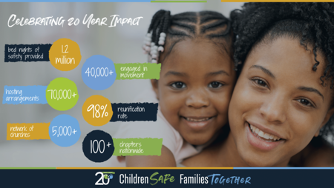
After 20 years and with 120 chapters across the United States, Safe Families for Children has amassed a strong track record of results. They have a network of 5,000 churches and 50,000 volunteers supporting their mission. They have a 98% reunification rate between parents and familiesand have arranged 70,000 hosting placements.This faith-based, community-focused model is having a transformative impact as they work to keep families intact and children cared for.

In part because of the Families First Prevention Services Act, more organizations working on child welfare issues are employing an evidence-based approach. Safe Families for Children is no different.

From 2016-2018, Safe Families for Children evaluated 99 families and their 216 children in Illinois over the course of a 2-year period. Among its notable findings were:

  • 78% of families that received support from Safe Families for Children were diverted from protective custody, compared with 47% of non-enrolled participants.
  • 89% of those working with Safe Families for Children kept their children in their homes one year after the hosting service concluded. This is compared with 65% of families not receiving their receives.

As policymakers work to improve our nation’s foster care system, they must also help prevent children from being separated from their families in the first place. This is where groups like Safe Families for Children play a crucial role. The organization is strengthening bonds in communities across the country by creating networks of support for parents and children in times of their greatest need. The American Idea Foundation is proud to team with legislators as they expand the use of evidence-based practices in the child welfare space and work with organizations like Safe Families for Children to ensure every child has a chance to thrive and prosper. To learn more about the American Idea Foundation’s 2024 grant recipients, click here. 

Filed Under: Blog, In The News Tagged With: Community Organizations Making a Difference

  • « Go to Previous Page
  • Page 1
  • Interim pages omitted …
  • Page 5
  • Page 6
  • Page 7
  • Page 8
  • Page 9
  • Interim pages omitted …
  • Page 47
  • Go to Next Page »

Footer

  • Facebook
  • Twitter
  • Contribute
  • About
    • Paul Ryan
    • Our Team
  • Mission
    • 2024 Progress Report
  • Approach
  • News
    • Blog
    • Press
  • Contact
Copyright © 2023 American Idea Foundation. Inc. All rights reserved.