• Skip to primary navigation
  • Skip to main content
  • Skip to footer
American Idea Foundation

American Idea Foundation

Measuring Results, Expanding Opportunity, Improving Lives.

  • Contribute
  • About
    • Paul Ryan
    • Our Team
  • Mission
    • 2025 Progress Report
  • Approach
  • News
    • Blog
    • Press
  • Contact

Press Release

Ryan announces 2023 grants to poverty-fighting groups around the United States

July 17, 2023 by Mike

By: AIF Staff

JANESVILLE, WI – Today, AIF President and former Speaker of the House Paul Ryan announced 7 non-profit organizations across the United States will be receiving financial support and strategic assistance from the American Idea Foundation in 2023 as they continue expanding economic opportunities and reducing poverty in their communities.

In 2022, the American Idea Foundation issued a handful of grants to front-line organizations developing evidence-based solutions to address issues like recidivism, financial literacy and entrepreneurship in underserved communities, early childhood health, and family well-being. Throughout the year, Ryan and his Foundation visited these organizations, offered strategic advice, shared policy expertise, and elevated the groups’ efforts in a variety of ways. It will expand on those efforts in 2023 with a new round of grant recipients.

Each of the 2023 grant recipients are making enormous differences in people’s lives. The funds and support provided by the American Foundation will be used primarily to develop additional data and evidence around specific poverty-fighting strategies around the country.

In announcing the American Idea Foundation’s 2023 grant recipients, Paul Ryan said:  

“Working with these amazing organizations and supporting their evidence-based approaches to fighting poverty is one of the most rewarding parts of my post-Congressional career. These groups are simply amazing. Their work is inspiring.

Last year, I spent time with two of our grant recipients, Gatekeepers in Hagerstown and Corner to Corner in Nashville, and saw first-hand the profound impact these organizations have. Our grant recipients are transforming communities, building ecosystems of support, and lifting people up daily. These groups and their leaders are committed to developing evidence that validate their approaches and I truly believe this is how America moves the needle on poverty.

This isn’t about partisanship or politics. It is about solving problems, helping people, and making the American Dream more accessible. These groups are doing precisely that and it’s why I am so excited to partner with these organizations in the year ahead.”

Started by Ryan in October 2019, the American Idea Foundation believes by taking the politics out of poverty-fighting and focusing on outcomes and results, successful programs can be scaled, elevated, and replicated. The Foundation believes this approach – prioritizing what works and validating these interventions with evidence — will provide policymakers with a better blueprint to address the challenges facing individuals and communities across the United States.

The 2023 American Idea Foundation grant recipients are….

Bernie’s Book Bank

Located in Chicago, Illinois, Bernie’s Book Bank creates pathways to success through book ownership by providing children and families access to books and giving children books of their own. Founded in 2009, Bernie’s Book Bank has long believed reading is one of the most important skills a child can possess, which is why it gives free, quality books to children to build personal libraries.

Since its founding, Bernie’s Book bank has sourced, processed, and distributed over 25 million books and delivered them directly to the children they serve via the school districts and early childhood programs in the Chicagoland area. The story and growth of Bernie’s Book Bank is astonishing. They have helped countless children learn how to read and develop comprehension skills which lay the foundation for more educational opportunities and a pathway out of poverty.

Bottom Line

Originally located in Boston, MA before expanding nationally, Bottom Line partners with degree-aspiring students of color from under-resourced communities to help them get into college, through college, and out into the workforce.

Founded in 1997, Bottom Line does this by pairing mentors with first-generation college students from low-income backgrounds, shepherding students through the college application process, and sticking with them throughout college by offering one-on-one support through graduation. Bottom Line’s goal is to create a far-reaching ripple effect by using the transformative power of a college degree to mobilize careers that lift up individuals, families, and communities. The organization currently serves over 7,000 students and the early impact of their program, as evidenced in a 2021 randomized controlled trial, are promising.

Brigid’s Path

Operating in Kettering, Ohio,Brigid’s Path was founded in 2014 to care for babies and mothers in crisis with grace, love and hope. It was the first in-patient, newborn recovery center in Ohio.

The organization’ primary purpose is to care for infants who were born exposed to an addictive substance like opioids or other drugs. Brigid’s Path employs the latest therapeutic techniques to help babies be as comfortable as possible while they experience withdrawal. At a critical stage in a newborn’s development, the medical staff and volunteers of Brigid’s Path shower them with love and attention 24 hours a day, 7 days a week. The organization believes in the strength of families and that families can – and do – contribute to the successful treatment of these babies. As they help newborns, Brigid’s Path also works with community partners to provide resources for their moms to achieve the stability that will ultimately help them care for their children for both the near and long-term.

Friends of the Children

Friends of the Children is a national non-profit organization that selects and invites youth – all of whom have unique talents, interests and dreams, and face multiple systemic obstacles – to be paired with a paid, professional mentor called a Friend. The organization hires and trains Friends to support youth from as early as age 4 through high school graduation. Friends spend a minimum of 14 to 16 intentional hours per month with each child and the Friends’ full-time job is to empower and support youths and their caregivers.

Friends of the Children revolutionized the youth mentoring field by creating the first and only long-term professional mentoring program in the country. They focus on youth who are facing the greatest obstacles, such as those who facing trauma or dealing with adverse early-childhood experiences, and help them develop skills like trust, empathy, and healthy communication. Friends of the Children has long been a leader in the evidence-based policy space, participating in the longest-running youth mentoring randomized control trial in the country.

Per Scholas

A nationally recognized non-profit with campuses in 20 cities, Per Scholas believes a thriving workforce starts with equitable access to education. To accomplish this goal, they have created an evidence-based, professional development program that provides individuals with tuition-free technology training and skills for high-growth careers.

Aiming to educate 4,500 students in 2023, Per Scholas provides customized training and job placement services for low-income workers focusing primarily on the information technology sector. Its core mission is to advance economic equity through rigorous training for tech careers and to connect skilled talent to leading businesses. As their 2022 Annual Report showed, their approach is working as the program has an 8:1 economic return generated for every dollar invested in Per Scholas.

Wisconsin Inmate Education Association

The Wisconsin Inmate Education Association is focusing on helping men and women incarcerated in the Wisconsin prison system transform their lives through the completion of an in-prison college curriculum which provides them with a Bachelor of Arts degree in Biblical Studies.

By encouraging inmates to embrace an alternative identity centered around faith and education, WIEA believes their intervention will lower levels of misconduct, stimulate spiritual transformations, and improve families and communities by changing behaviors for the better. The Wisconsin Inmate Education Association’s approach is evidence-based and they measure success by looking at factors like personal transformation, violence reduction, the community and family impact, and recidivism.

Women’s Bean Project

Located in Denver, Colorado,the Women’s Bean Project is a transitional employment program serving those women who have struggled to obtain and maintain employment. The organization’s goal is to change women’s lives by providing them stepping stones to self-sufficiency through work.

Participants complete a 6-9 month vocational and educational program and upon graduation, receive a full-time job as a production assistant in the Women’s Bean Project’s food manufacturing business. The Women’s Bean Project helps women achieve independence by giving them the readiness skills, talents, and opportunities to break the cycle of poverty. Since its founding, the Women’s Bean Project has blossomed into a successful commercial enterprise and their products are now sold in 1,000 stores nationwide. They generated over $2 million in revenue last year and helped hundreds of women get back on track.

Filed Under: In The News, Press Release Tagged With: Community Organizations Making a Difference

At Capitol portrait unveiling, Ryan reflects on achievements as Speaker of the House & time in Congress

May 15, 2023 by Mike

By: AIF Staff

Washington, DC – This afternoon at the United States Capitol, a portrait commemorating former Wisconsin Congressman Paul Ryan’s time as the 54th Speaker of the House was unveiled in a ceremony attended by a bipartisan group of Congressional leaders, current and former Members of Congress, and Ryan’s family, friends, and members of his staff.

The four Congressional leaders, Speaker Kevin McCarthy (R-CA), Leader Hakeem Jeffries (D-NY), Leader Chuck Schumer (D-NY), and Leader Mitch McConnell (R-KY), spoke at the event recognizing Ryan’s contributions to the House of Representatives during his time as Speaker from October 2015 to January 2019. The event was also attended by former Speakers Boehner, Pelosi, and Gingrich.

Ryan’s portrait was painted by Leslie Bowman, an award-winning portrait artist from Minneapolis, Minnesota. Bowman was also commissioned to memorialize Ryan’s time leading the House Budget Committee and the House Ways and Means Committee.

The painting of Ryan will hang in the Capitol and is the latest addition to the historic Speaker’s Portrait Collection. 

Ryan, who served as Speaker of the House from October 2015 to January 2019, unveiled the portrait with his wife, Janna, and their children: Liza, Charlie, and Sam. Marking the occasion, Ryan said:

“Only in America is it possible to start a career in public service as an intern and end it as Speaker of the House.  Only in America could a 28-year-old kid from Janesville, Wisconsin be elected to Congress and go on to serve his hometown for two decades.

“Today is a tremendous honor. It’s an honor that I share with my family, friends, colleagues, and staff without whom none of this would have been possible. Helping my community and fighting for good public policies was the opportunity of a lifetime and I will forever be grateful for the opportunity to represent Wisconsin in the House and to lead the institution as Speaker.”

Reflecting on the three portraits she painted memorializing Ryan’s leadership positions in Congress, artist Leslie Bowman said:

“I believe a great portrait should be a fine painting as well as a physically accurate and emotionally evocative portrayal of the subject. This is accomplished not only by creating a good likeness but also through the ability of the artist to see and reflect the inner qualities of the person she is painting.

“Throughout our history, portraits have been commissioned to honor those who have earned great recognition for their achievements. As a portrait painter I have had the rare, and cherished opportunity to render three visual legacies of Speaker Ryan, a man who serves our nation from the heart.”

For a high-resolution photo of Ryan’s portrait, please click HERE.

###

Filed Under: In The News, Press Release, Uncategorized

Panel Discussion: Ryan & practitioners discuss Evidence based programs to expand opportunities

February 27, 2023 by Mike

By: AIF Staff

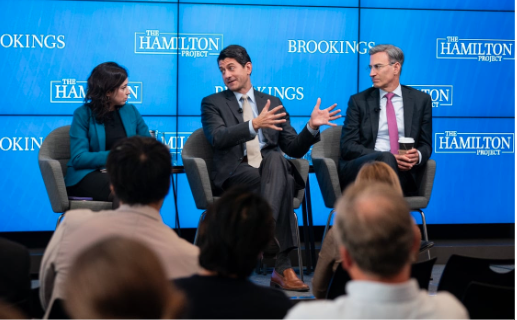
Washington, DC – Last week, American Idea Foundation President and former Speaker of the House Paul Ryan facilitated a conversation with experts researching social mobility and leaders of non-profit organizations focused on fighting poverty. The discussion, hosted by the American Enterprise Institute, featured:

  • Shana Berkeley, the Executive Director of Corner to Corner, a Nashville based non-profit working with female entrepreneurs on business development and financial literacy; 
  • Bill Gaertner, the Founder of Gatekeepers, a Maryland-based organization helping ex-offenders rejoin communities following interactions with the criminal justice system;
  • Scott Winship, a Senior Fellow at the American Enterprise Institute and head of the Center on Opportunity and Social Mobility, that produces research on poverty alleviation, workforce development, vocational education, housing and urban policy, and the revitalization of key institutions.

The purpose of the panel was to detail and discuss real-world, evidence-based approaches to expand economic opportunities in underserved communities. Both Gatekeepers and Corner to Corner have partnered with Ryan’s American Idea Foundation and Notre Dame’s Lab for Economic Opportunities (LEO) to conduct rigorous randomized controlled trials to determine the efficacy and impact of their programs. The hope is, if these trials yield positive results, that these successful solutions can be scaled and replicated in other areas across the country helping to improve more people’s lives.

Video of the panel discussion is accessible here and some noteworthy excerpts (edited lightly for clarity) are included below.

Ryan on getting a perspective from front-line practitioners successfully fighting poverty:

“I’m excited about talking to people who are on the ground, who are fighting poverty person to person with specific ideas and proven solutions. Typically, what we have is policymakers speaking to people telling them what they ought to do and how they ought to make a positive change, but today, we’re reversing those roles. We’re going to hear from poverty-fighters about what policymakers can do to make a big difference and improve people’s lives when it comes to fighting poverty.

“As I mentioned, I visited both of these institutions, Gatekeepers and Corner to Corner, and they’re doing really impressive work. Gatekeepers works with individuals both inside and outside of prison to make sure that they’re making good on their second chance. Gatekeepers is often the very first stop that returning citizens make on their way out of prison and Corner to Corner is doing amazing work promoting entrepreneurship. I’ve seen it firsthand. It’s really something that’s exciting to watch and witness. One of the most impactful programs is The Academy, which provides aspiring business owners with the skills necessary to plan, start, and grow their own companies. So, everyone should be excited to learn from these individuals who are fighting poverty and directly improving people’s lives. “

Shana Berkeley on Corner to Corner’s “secret sauce” & Bill Gaertner on Gatekeeper’s key to success:

Berkeley: “One is everybody has passion. We don’t give them that and when you see people already having passion, you know that they have what it takes because it’s gotten them where they are and they are already on the road to where we are able to conspire with them and collaborate with them. You’re not saving them. You’re helping them and they’re helping you and that experience has been life-changing…”

Gaertner: “Our secret sauce is the fact that we’re run by ex-offenders. Almost everyone involved with our program are ex-offenders…. We all got together and realized that we could do something by having ex -offenders run this program [so that was] the secret sauce at the start.”

Shana Berkeley on using evidence to help validate Corner to Corner’s amazing work:

“The fact of the matter is randomized control studies and having data to really understand what you’re doing is very important. And so, when we partnered with the Lab for Economic Opportunities (LEO), we knew that it would be challenging and we knew that there would be some things that we would have to change, like having a control group.

“We actually had to learn what a control group was but it’s necessary because if you want to see what works and you do all this work and you hire all these people, you want to know what is the part that really makes a difference? How can you double down on that? And the things that are just lukewarm – okay, it was a great idea five years ago but it no longer works in the society or in the community that you live in – how can you then pivot? So, it’s necessary for us to be able to have measurement, to know what works, to share the story, to replicate it really well because, in our heart, we want to go into other communities and not make them [repeat] the last five years but instead get them to use the really good stuff.”

Bill Gaertner on how Gatekeepers is growing and making an impact in Maryland communities:

“Hagerstown is a prison-centric town. There are three state penitentiaries in Hagerstown and there’s one Detention Center. Our local detention center has around 370 people so when we were approached by LEO to join a study, it was like a forced fit. At first, we were the smallest group that they ever dealt with and so we kept talking with them but because it’s a prison-centric county, it could impact 40,000 people in the community.

“And Paul and I talked about this. He came to Hagerstown and we threw a big lunch that had 100 people there. We had the mayor and the whole village came out, but until ex-inmates took over the reentry program in that town, nothing happened. [The community] pretended that there were no prisons here. People did not know the difference between a prison and a detention center or the local county jail and that’s where all the poverty comes from…. So, we have a lot of problems in Hagerstown, but it was the perfect place to do this right.

“Keith [Roys of Gatekeepers] and I just established, thanks to the re-entry people who run the state of Maryland, we have an office of ex-offenders in the parole office. So, you report to your parole office when you’re coming back to Washington County and if you’re at the parole office and you have basic needs, you go down to the end of the hall and see Gatekeepers for your basic needs…

“That’s why we call it Gatekeepers. We try to meet as many people we can at the gate when they’re coming back to our county and I’m very proud to say that we’re the only organization in every penitentiary in the state of Maryland.

“We are operating within one of the penitentiaries that I was locked up in and we started, along with the re-entry people from the state of Maryland, a wing for re-entry. Right now, there are 18 men in there and they’re all getting out within a year so these people are coming back to Western Maryland and we’re trying to focus on taking care of our local people. These 18 men are going to have a reentry program for one year with ex-offenders leading it. So, we’re very proud about that.

“We’re inside the parole office. Now, we’re inside the prisons. We have a work release area that we’re helping run and we’re in Cumberland, Maryland Federal Penitentiary doing Business of Living seminars and we’re infiltrating the inside of the prison. The only way it’s going to work is from the inside out, not from the outside in. I know policy people might not like to hear that but you can’t shoot the deer from the lodge. You have got to work from the inside out.”

AEI’s Scott Winship on the role thought-leaders can play to assist front-line organizations:

“At our best, I think the folks who are in positions like mine, including policymakers, we’re coming up with ideas that can affect a lot of people, so those people in Nashville, people in Baltimore, in Hagerstown, and then a bunch of other places as well. We can see a lot of patterns that may not be apparent on the ground, put all the ideas and observations back together, and try to come up with solutions that are appropriate to the big problems of our time.

“At our worst, we’re coming up with incredibly impractical ideas without having set foot in some of the settings that you are working in every day. We are coming up with broken, utopian schemes that are basically unworkable. And so, it’s really important for folks in DC who are doing policy development and policy thinking, to have this reciprocity with folks who are everyday getting up and helping real people in the real world.

“We need to be able to understand from the folks who are there on the ground, the importance of things like social capital, which is a word that really speaks to the importance of relationships, like the fact that you have ex-offenders who are more effective at doing the things that [Gatekeepers is] doing because of their experience….

“I think, at our best, we can do things like what LEO is doing, where they have some expertise in being able to design program evaluations and can show you what is working, things that aren’t working as well, and they’re able to translate what you’re doing.”

This panel discussion with on-the-ground practitioners was part of a quarterly series of policy conversations hosted by the American Idea Foundation to draw attention to policies aimed at expanding economic opportunities. Past policy panels have focused on orienting our tax code towards growth, innovative financial tools to support workers, creating a clearinghouse for evidence-based programs, building a 21st century workforce, reforming the Earned Income Tax Credit, reducing recidivism and promoting 2nd chances, and properly implementing Opportunity Zones. 

Note: Ryan is a visiting fellow at the American Enterprise Institute.

###

Filed Under: In The News, Press Release Tagged With: Validating Reforms that Expand Opportunity

  • « Go to Previous Page
  • Page 1
  • Interim pages omitted …
  • Page 13
  • Page 14
  • Page 15
  • Page 16
  • Page 17
  • Interim pages omitted …
  • Page 27
  • Go to Next Page »

Footer

  • Facebook
  • Twitter
  • Contribute
  • About
    • Paul Ryan
    • Our Team
  • Mission
    • 2025 Progress Report
  • Approach
  • News
    • Blog
    • Press
  • Contact
Copyright © 2023 American Idea Foundation. Inc. All rights reserved.